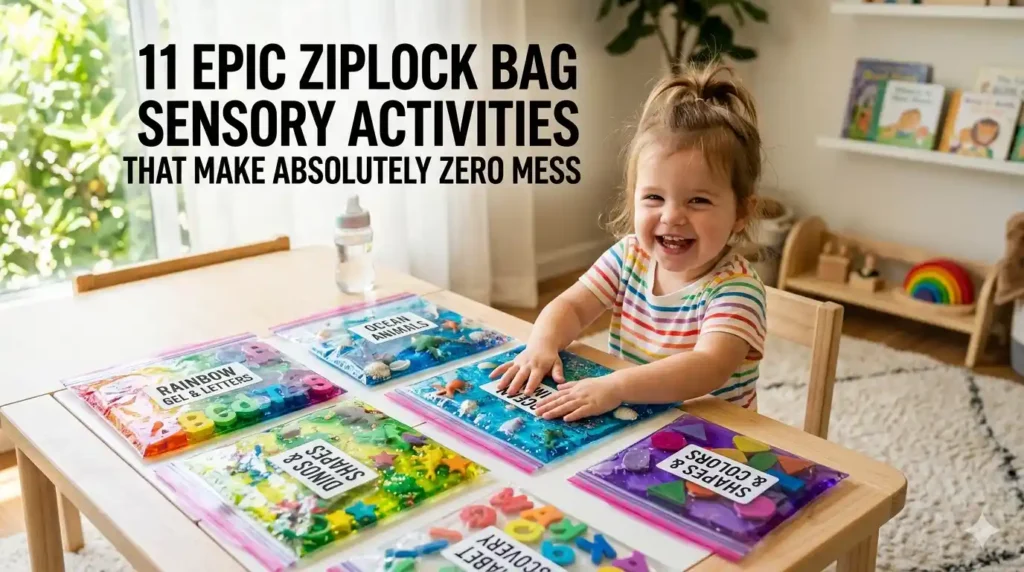
Keeping little ones entertained while protecting your floors, walls, and furniture can feel like an impossible balancing act. Babies and toddlers learn best through hands-on sensory play, but many traditional sensory activities come with spills, sticky fingers, and cleanup that exhausted parents simply don’t have time for. The good news is that a simple ziplock bag can transform sensory play into a contained, engaging experience that children love.
Ziplock bag sensory activities offer a wonderful way to encourage exploration, movement, and learning while keeping messes safely sealed away. Whether you have a curious baby, an active toddler, or a preschooler who enjoys experimenting with colors and textures, these easy sensory play ideas provide valuable developmental benefits without turning your living room into a disaster zone.
11 Epic Ziplock Bag Sensory Activities That Make Absolutely Zero Mess
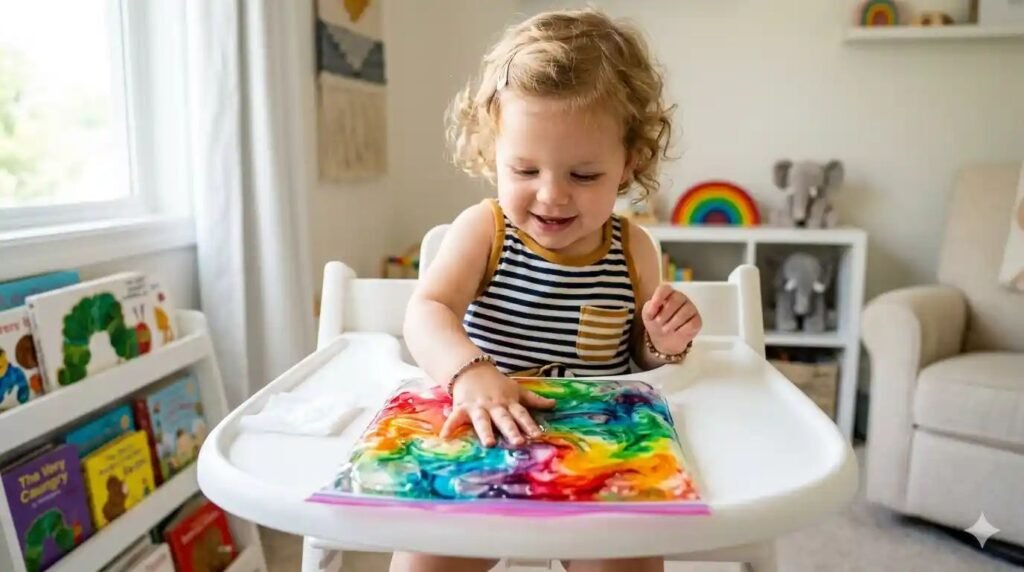
1. Rainbow Gel Squish Bag
Materials Needed
- Large ziplock freezer bag
- Hair gel or clear gel
- Food coloring
- Strong tape
- Flat surface or highchair tray
Step-by-Step Instructions
- Fill the ziplock bag with clear hair gel.
- Add several drops of different food coloring shades.
- Seal the bag tightly and reinforce the seal with tape.
- Gently spread the gel around the bag.
- Place it on a table, floor, or highchair tray.
- Encourage your child to press, poke, and swirl the colors.
- Talk about the colors they see as they move and mix.
- Extend the activity by tracing shapes, letters, or simple patterns on the outside of the bag.
What They Are Learning
This activity supports:
- Fine motor skills through pressing and poking
- Hand-eye coordination
- Color recognition
- Sensory processing
- Early language development
- Cause-and-effect understanding
Health & Development Benefits
Sensory experiences help young brains build connections between what children see, feel, and do. When babies press the gel and watch colors move, they begin understanding that their actions create results. This is an important foundation for cognitive development.
The resistance from the gel provides gentle muscle work for little hands and fingers. These movements help strengthen the small muscles needed later for drawing, writing, buttoning clothes, and self-feeding.
The calming motion of moving colors around the bag can also support emotional regulation. Many children find repetitive sensory play soothing when they are feeling overstimulated or restless.
Because everything stays sealed, children can fully focus on exploration without constant reminders not to make a mess.
Safety Tips
- Always supervise during play.
- Use heavy-duty freezer bags.
- Check for leaks before use.
- Avoid small loose items inside the bag for babies who mouth objects.
Parent-to-Parent Note
Most babies are fascinated by the way the colors slowly move through the gel and often return to this activity several times in one day.
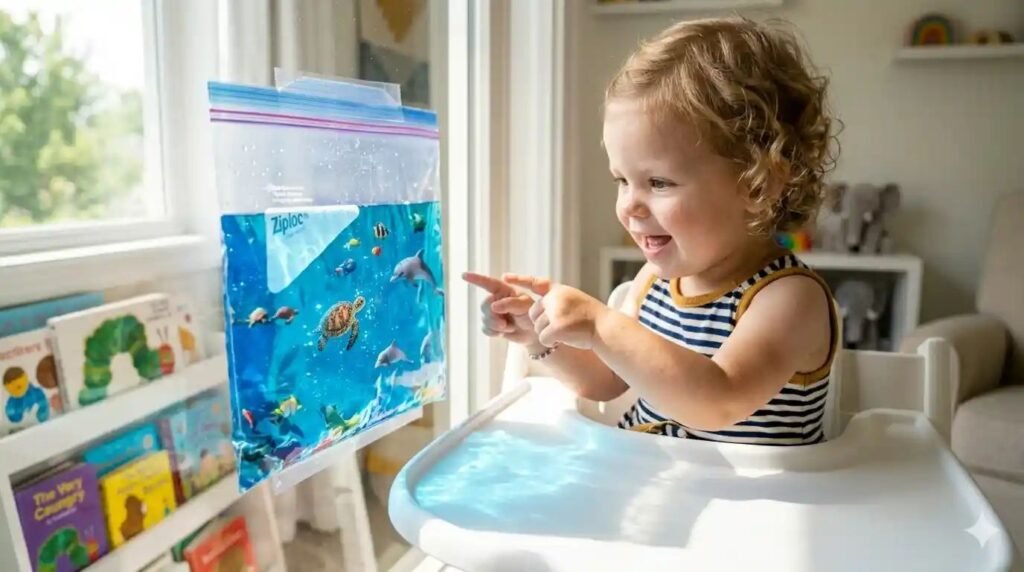
2. Ocean Discovery Sensory Bag
Materials Needed
- Ziplock freezer bag
- Water
- Blue food coloring
- Plastic ocean-themed toys
- Clear tape
Step-by-Step Instructions
- Fill the bag halfway with water.
- Add blue food coloring.
- Place ocean animal toys inside.
- Remove excess air and seal tightly.
- Tape the bag to a floor, wall, or window.
- Encourage your child to move the animals through the water.
- Name the sea creatures together.
- Create simple stories about underwater adventures.
What They Are Learning
- Vocabulary development
- Sensory exploration
- Hand strength
- Problem-solving
- Early science concepts
- Imaginative play
Health & Development Benefits
Moving floating objects through water creates resistance that encourages hand and finger strength. These small muscle-building experiences are important for future self-care and school readiness skills.
Children also build language skills when adults describe actions, animals, and locations. Hearing words repeatedly in meaningful contexts supports vocabulary growth.
The visual movement of water captures attention naturally, helping children practice focus and concentration. Sustained attention is a skill that develops gradually through engaging activities like this.
Storytelling opportunities encourage creativity while helping children make connections between language and experiences.
Safety Tips
- Ensure all objects are larger than choking hazard size.
- Inspect bags regularly for damage.
- Maintain adult supervision.
Parent-to-Parent Note
Don’t be surprised if your toddler spends more time naming the animals than moving them around. That’s valuable learning too.
3. Frozen Paint Sensory Bag
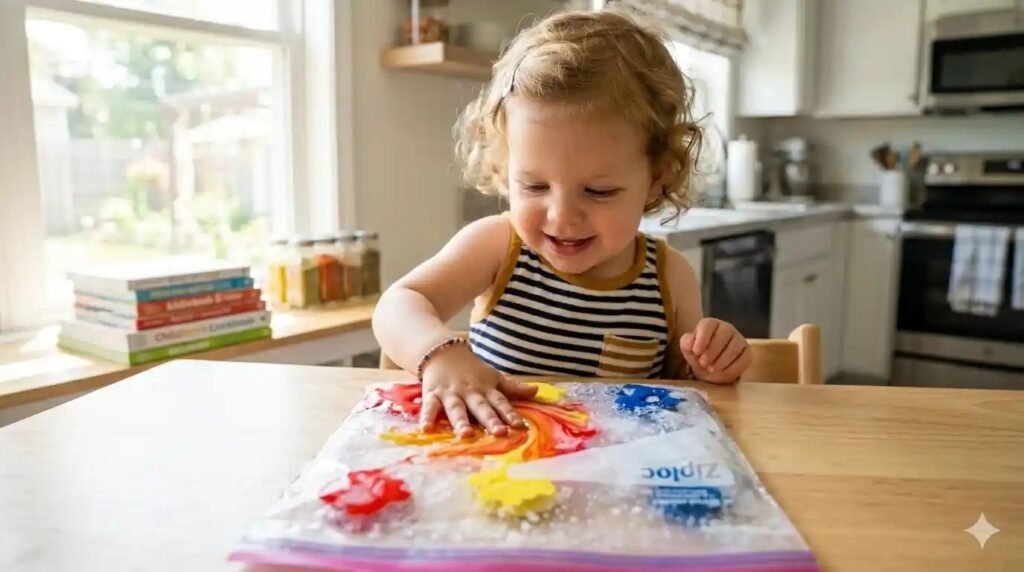
Materials Needed
- Ziplock bag
- Washable paint
- Tape
- Freezer
Step-by-Step Instructions
- Add several paint colors to the bag.
- Seal securely.
- Freeze partially for a few hours.
- Place the bag on a tray.
- Let children push and manipulate the colors.
- Watch color blending happen inside the bag.
- Discuss color changes together.
What They Are Learning
- Color mixing
- Sensory awareness
- Fine motor development
- Scientific observation
- Vocabulary building
Health & Development Benefits
Cold sensory experiences expose children to different textures and temperatures in a safe way. These experiences help the nervous system process sensory information more efficiently.
Color experimentation introduces early science concepts. Children observe changes and begin making predictions about what might happen when colors combine.
The physical effort required to move semi-frozen paint strengthens hand muscles and improves motor planning skills.
Children often remain engaged for extended periods because the colors change gradually, encouraging patience and observation.
Safety Tips
- Use non-toxic washable paint.
- Avoid extremely frozen bags that become hard.
- Supervise throughout play.
Parent-to-Parent Note
A towel underneath helps with condensation, even though the activity itself stays completely mess-free.
4. Alphabet Search Bag
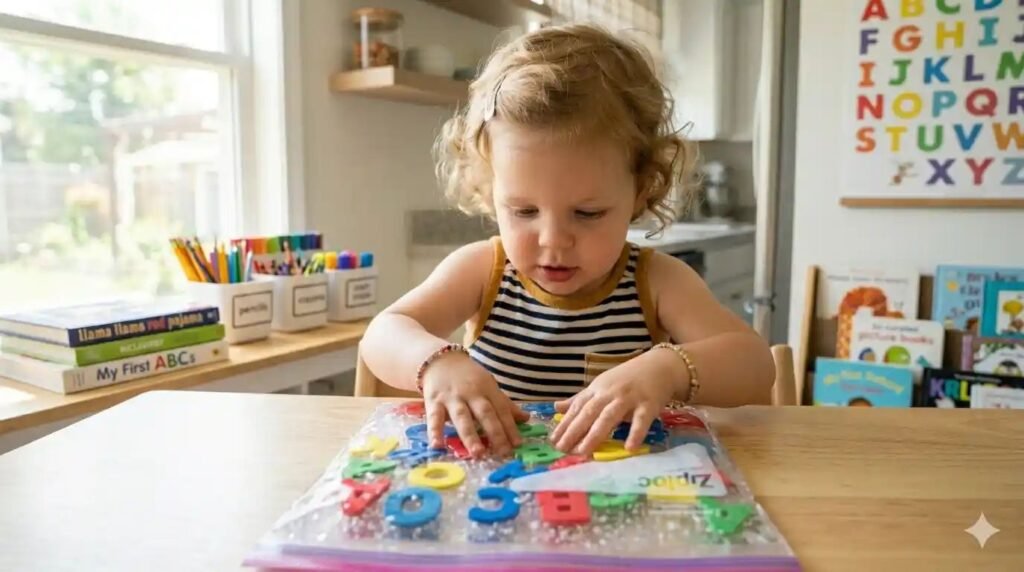
Materials Needed
- Ziplock bag
- Hair gel
- Foam letters
- Tape
Step-by-Step Instructions
- Fill the bag with gel.
- Add foam alphabet letters.
- Seal and tape securely.
- Ask children to locate specific letters.
- Name letter sounds together.
- Form simple words with older children.
What They Are Learning
- Letter recognition
- Pre-reading skills
- Visual tracking
- Fine motor control
- Language development
Health & Development Benefits
Early literacy experiences work best when they feel playful rather than instructional. This activity allows children to explore letters through movement and touch.
Visual tracking skills develop as children search through the gel. These abilities later support reading and scanning text.
The challenge of finding hidden letters encourages persistence and problem-solving. Children learn that effort can lead to success.
Language interactions with caregivers build stronger communication skills and reinforce early reading foundations.
Safety Tips
- Ensure letters are securely enclosed.
- Use age-appropriate expectations.
- Supervise younger children.
Parent-to-Parent Note
Toddlers often enjoy simply moving the letters around long before they recognize them, and that’s perfectly appropriate.
5. Glitter Galaxy Sensory Bag
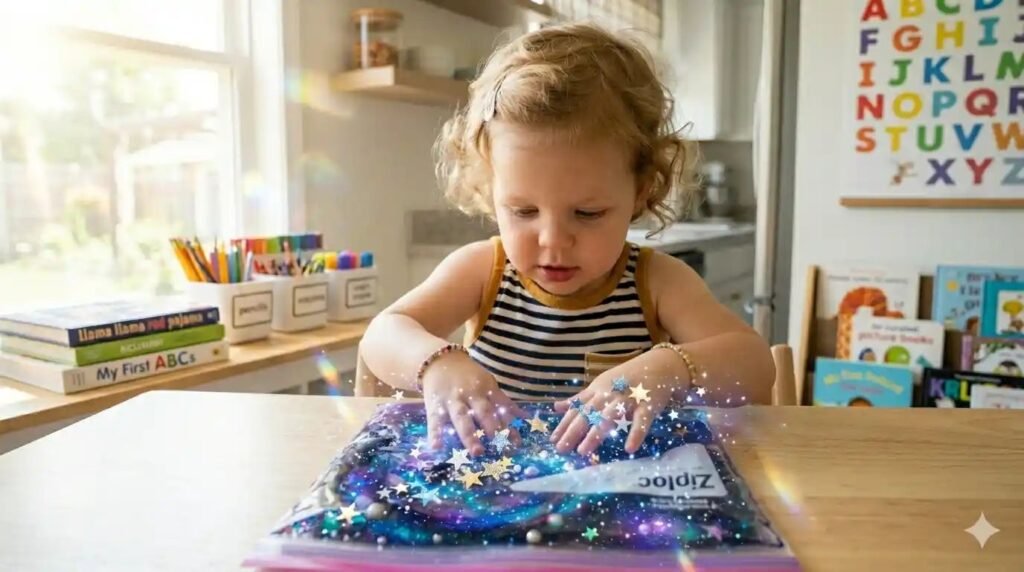
Materials Needed
- Ziplock freezer bag
- Hair gel
- Glitter
- Star confetti
- Tape
Step-by-Step Instructions
- Fill the bag with gel.
- Add glitter and confetti.
- Seal tightly.
- Tape securely.
- Let children move the stars around.
- Create space-themed conversations.
- Trace constellations on the bag exterior.
What They Are Learning
- Visual tracking
- Imagination
- Fine motor skills
- Language development
- Attention skills
Health & Development Benefits
The slow movement of glitter can be surprisingly calming for children. Watching and manipulating visual patterns may help some children settle during transitions.
Imaginative play strengthens flexible thinking and creativity. Children begin creating stories and explanations for what they observe.
Tracking tiny objects visually supports eye coordination skills. These skills contribute to reading readiness and everyday visual tasks.
This activity offers a screen-free opportunity for quiet engagement while still stimulating curiosity and learning.
Safety Tips
- Seal thoroughly.
- Use large confetti pieces when possible.
- Always supervise.
Parent-to-Parent Note
Many parents find this activity especially helpful during waiting periods or quiet time.
6. Farm Animal Adventure Bag
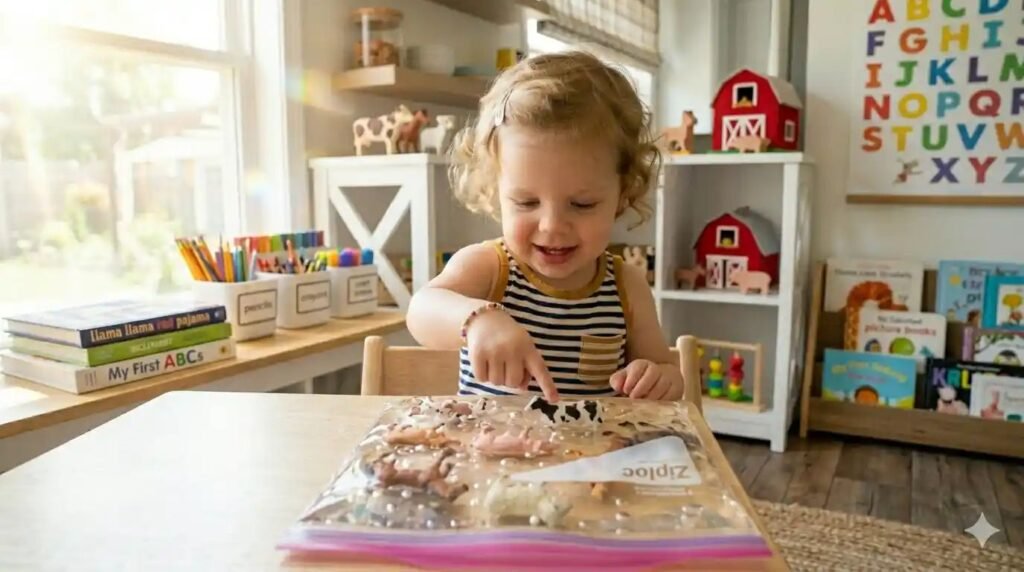
Materials Needed
- Ziplock bag
- Clear gel
- Small farm animal figures
- Tape
Step-by-Step Instructions
- Add gel to the bag.
- Insert farm animal toys.
- Seal securely.
- Encourage movement and storytelling.
- Name animals and sounds.
- Create simple farm scenarios.
What They Are Learning
- Animal recognition
- Vocabulary
- Imaginative thinking
- Fine motor skills
- Social-emotional development
Health & Development Benefits
Pretend play supports emotional development because children practice understanding roles, actions, and relationships.
Naming animals and sounds builds language skills naturally. Repetition through play strengthens memory and word retrieval.
Manipulating objects inside the bag improves hand coordination and precision.
Children gain confidence when they successfully direct their own play experiences and create simple narratives.
Safety Tips
- Ensure toys are age appropriate.
- Reinforce bag seals.
- Supervise closely.
Parent-to-Parent Note
Animal sounds often become the most exciting part of this activity for younger toddlers.
7. Shape Hunt Sensory Bag
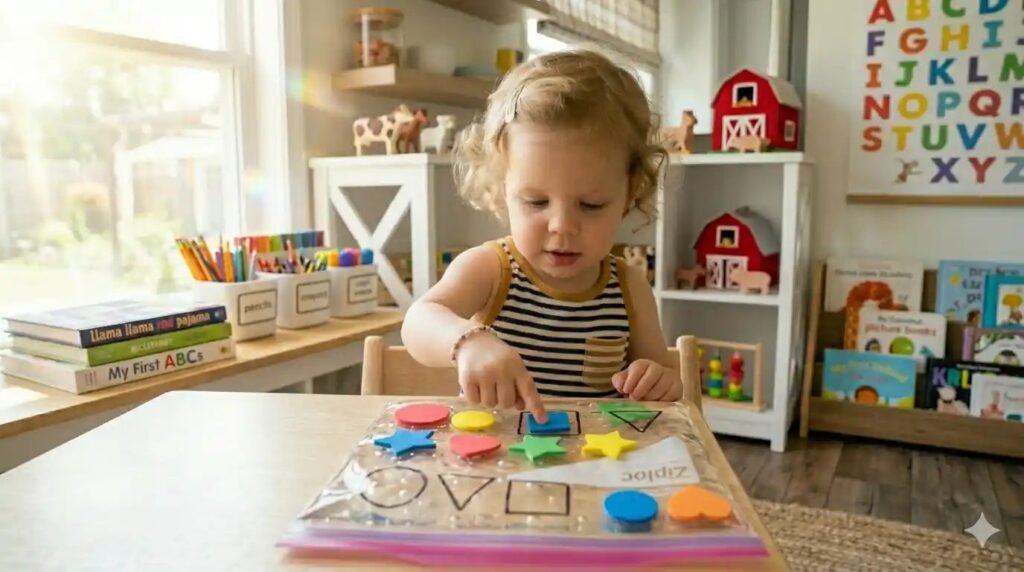
Materials Needed
- Ziplock bag
- Hair gel
- Foam shapes
- Marker
Step-by-Step Instructions
- Add gel and shapes.
- Seal the bag.
- Draw matching shape outlines on the outside.
- Invite your child to move shapes into place.
- Name shapes repeatedly.
- Increase complexity over time.
What They Are Learning
- Shape recognition
- Problem-solving
- Fine motor control
- Visual discrimination
- Early math skills
Health & Development Benefits
Matching activities strengthen cognitive pathways related to sorting, categorizing, and identifying similarities and differences.
The coordination needed to maneuver shapes promotes precision and hand-eye control.
Shape awareness supports later mathematical understanding by helping children recognize patterns and spatial relationships.
The challenge level can grow with your child, providing ongoing opportunities for mastery and confidence building.
Safety Tips
- Use large foam shapes.
- Check seals before play.
- Provide supervision.
Parent-to-Parent Note
Children often invent their own matching rules, which is a great sign of creative thinking.
8. Bubble Wrap Squish Bag
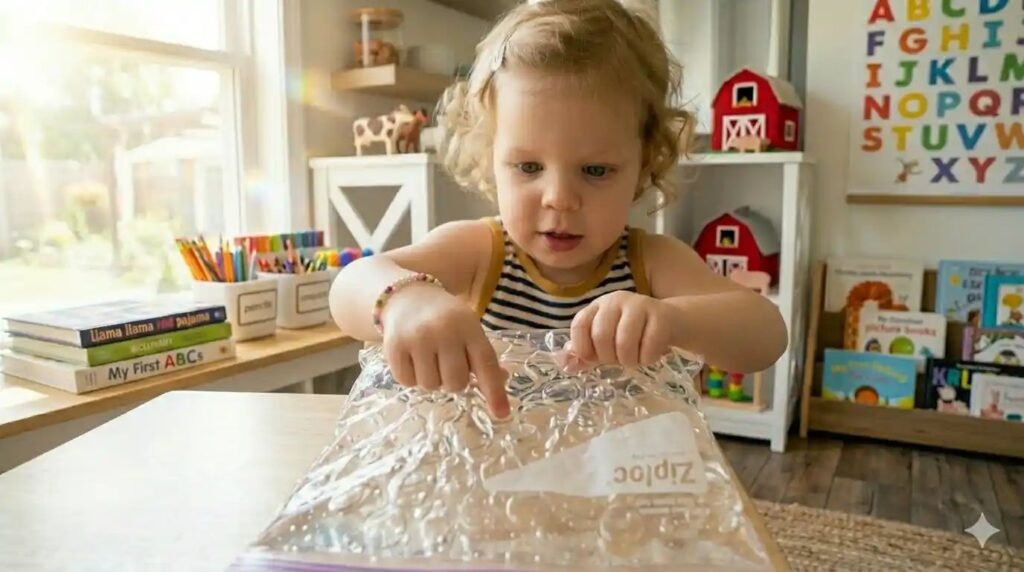
Materials Needed
- Ziplock bag
- Bubble wrap pieces
- Gel
- Tape
Step-by-Step Instructions
- Cut bubble wrap into sections.
- Place inside the bag with gel.
- Seal securely.
- Encourage squeezing and pressing.
- Compare textures together.
What They Are Learning
- Texture awareness
- Sensory discrimination
- Fine motor strength
- Descriptive language
Health & Development Benefits
Experiencing different textures helps children learn how to interpret sensory information from their environment.
Pressing and squeezing develops hand strength needed for many daily activities.
Describing sensations encourages language growth and emotional expression.
Sensory exploration also supports curiosity and confidence in trying new experiences.
Safety Tips
- Keep bubble wrap sealed inside.
- Supervise continuously.
- Replace damaged bags immediately.
Parent-to-Parent Note
Children are often surprised by how different the bubbles feel when hidden inside gel.
9. Counting Bead Sensory Bag
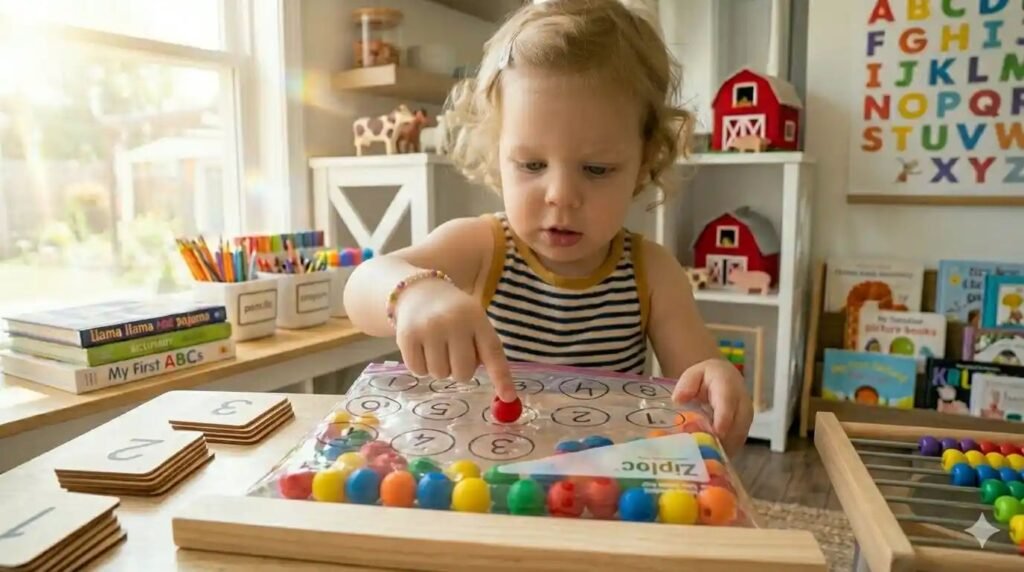
Materials Needed
- Ziplock freezer bag
- Hair gel
- Large counting beads
- Marker
Step-by-Step Instructions
- Place gel and beads inside the bag.
- Seal tightly.
- Draw number circles on the exterior.
- Encourage moving beads into groups.
- Count together.
- Increase numbers gradually.
What They Are Learning
- Early math concepts
- Counting skills
- One-to-one correspondence
- Fine motor coordination
Health & Development Benefits
Hands-on counting experiences help children understand numbers more effectively than memorization alone.
Moving beads through resistance supports hand strength and motor planning.
Children learn persistence as they work toward placing beads accurately.
Math confidence develops when children interact with numbers through enjoyable play experiences.
Safety Tips
- Use large beads only.
- Inspect seals regularly.
- Supervise at all times.
Parent-to-Parent Note
Even children who aren’t interested in counting often enjoy simply moving the beads around.
10. Dinosaur Dig Sensory Bag
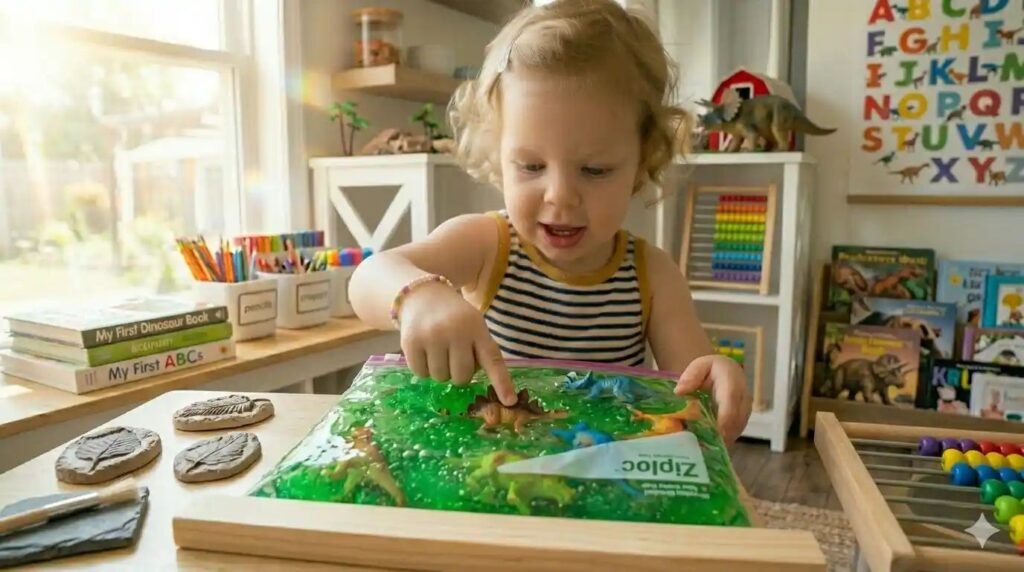
Materials Needed
- Ziplock bag
- Green gel
- Small dinosaur figures
- Tape
Step-by-Step Instructions
- Fill the bag with gel.
- Add dinosaur toys.
- Seal and tape securely.
- Hide dinosaurs within the gel.
- Encourage children to find each dinosaur.
- Discuss names, colors, and sizes.
- Create dinosaur adventures together.
What They Are Learning
- Problem-solving
- Vocabulary
- Visual tracking
- Imagination
- Fine motor development
Health & Development Benefits
Searching for hidden objects strengthens visual perception and concentration skills.
The playful challenge encourages children to stay engaged and work toward a goal, building persistence.
Imaginative dinosaur stories support language growth and creative thinking.
This activity combines movement, exploration, and learning without requiring screens or expensive materials.
Safety Tips
- Use age-appropriate dinosaur figures.
- Tape the seal securely.
- Maintain supervision.
Parent-to-Parent Note
Many children return to hidden-object activities repeatedly because each search feels like a new discovery.
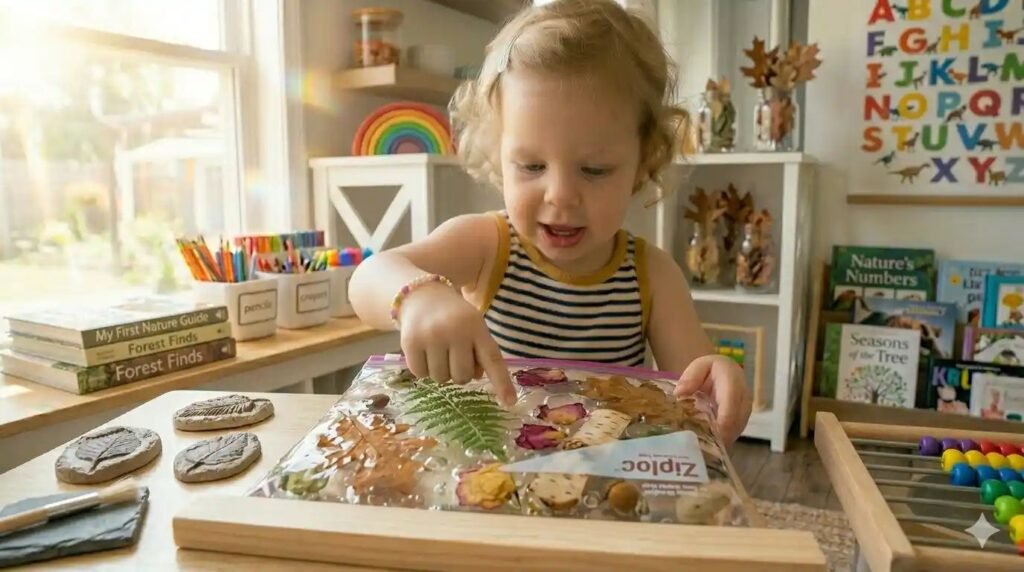
11. Nature Treasure Sensory Bag
Materials Needed
- Ziplock freezer bag
- Hair gel
- Large leaves
- Flower petals
- Small pinecones (too large to swallow)
- Tape
Step-by-Step Instructions
- Collect nature items during a walk together.
- Place a layer of gel inside the bag.
- Add leaves, petals, and other safe natural treasures.
- Seal and tape the bag securely.
- Invite your child to press, slide, and explore the items.
- Talk about colors, textures, and where each item came from.
- Compare different shapes and sizes.
- Extend the activity by recalling your outdoor adventure.
What They Are Learning
- Nature awareness
- Sensory processing
- Vocabulary development
- Observation skills
- Early science concepts
- Memory and recall
Health & Development Benefits
Connecting sensory play with real-world experiences helps children build meaningful learning connections. A leaf collected during a walk becomes more memorable when explored later through play.
Natural materials introduce a wider range of textures, shapes, and visual patterns than many manufactured toys. This variety supports sensory development and encourages curiosity about the world.
Talking about where items were found strengthens memory, sequencing, and language skills. Children learn that experiences can be revisited and discussed later.
This activity also nurtures an appreciation for nature while providing calm, screen-free engagement that supports focus and emotional regulation.
Safety Tips
- Avoid plants that may cause allergic reactions.
- Use only large natural items that cannot become choking hazards.
- Check materials for insects or sharp edges.
- Always supervise play.
Parent-to-Parent Note
Children often become surprisingly attached to leaves or flowers they collected themselves, making this activity extra engaging.
Before you gather supplies, remember that sensory play doesn’t need to be elaborate to be meaningful. A simple ziplock bag, a few household items, and your willingness to sit alongside your child for a few minutes can create rich learning opportunities that support healthy development.
Frequently Asked Questions
What age are ziplock bag sensory activities suitable for?
Most ziplock bag sensory activities can be introduced around 6 months of age when babies begin actively exploring their environment. Activities should always be adjusted for developmental level, and adult supervision is essential. Older toddlers and preschoolers can enjoy more advanced versions that include letters, numbers, shapes, and storytelling.
Are sensory bags safe for babies who put everything in their mouths?
Sensory bags can be a safer alternative to many sensory bins because the materials remain sealed inside. Use heavy-duty freezer bags, reinforce seals with strong tape, inspect for damage before each use, and supervise closely. Avoid including small objects that could become choking hazards if the bag were damaged.
How long do sensory bags usually last?
Most well-made sensory bags can last several weeks or even months depending on use. Freezer bags tend to be more durable than standard storage bags. Check regularly for leaks, weakened seams, or punctures and replace when necessary.
Why is sensory play important for child development?
Sensory play helps children learn through touch, sight, movement, and exploration. These experiences support brain development, language growth, fine motor skills, problem-solving, attention, and emotional regulation. Sensory activities also encourage curiosity and provide valuable screen-free learning opportunities during the early years.
Final Conclusion
When it comes to supporting healthy child development, some of the most effective activities are also the simplest. Ziplock bag sensory play gives babies, toddlers, and preschoolers the chance to explore colors, textures, movement, shapes, numbers, and imaginative ideas without creating extra stress for caregivers. These activities encourage learning through hands-on experiences, which is exactly how young children naturally make sense of the world around them.
As a pediatric professional and child development advocate, I often remind parents that meaningful play does not require expensive toys, elaborate setups, or perfectly planned schedules. What matters most is providing safe opportunities for exploration and responding to your child’s curiosity with warmth and encouragement.
If today’s activity only lasts five minutes before nap time, that’s okay. If your child wants to repeat the same sensory bag every day for a week, that’s okay too. Repetition is part of learning. The small moments spent squishing, pointing, talking, laughing, and exploring together are building important developmental foundations.
Give yourself credit for creating those opportunities. Your presence, attention, and encouragement are often the most valuable ingredients in any sensory activity. Happy playing!